Everything we shipped in October
Writing Voice, Empirical Tokens, workspaces that know what they hold, files on a memory, a Daydream that finds real talks for you, and Empirical in more places. The full list, in one page.
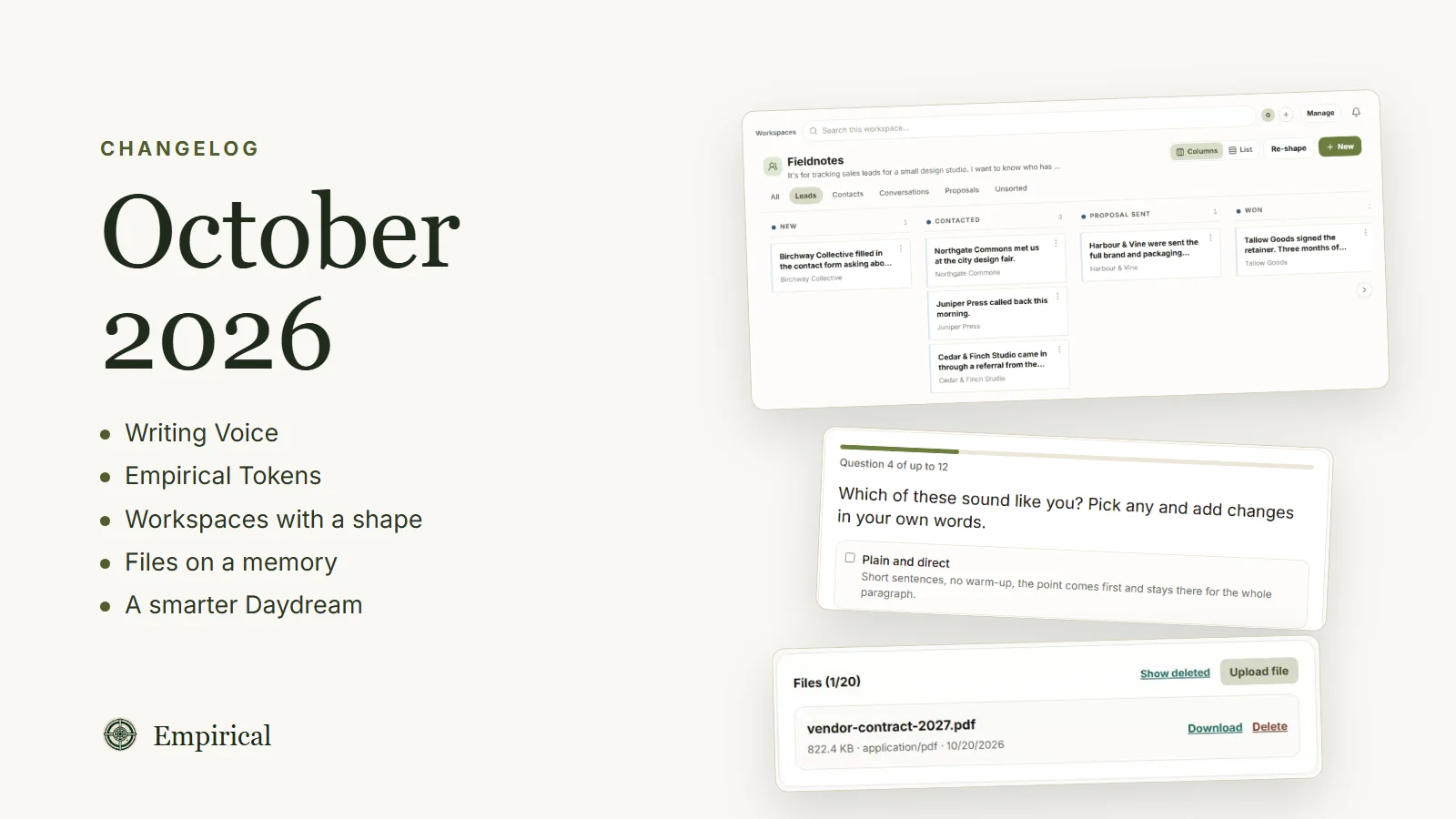
October was a big month. Here is all of it in one place, the headline features first and the smaller fixes after. If you only read one section, read the first one.
Writing Voice
Every AI assistant writes in the same voice by default, and it is nobody's. Writing Voice fixes that.
It is a guided interview. You paste two or three things you wrote, or describe how you want to sound. Then you pick the style options that sound like you, and compare short versions of the same message written four different ways, picking the one that sounds most like you each round. The page never tells you which style is which, and the order is shuffled, so you pick by ear.
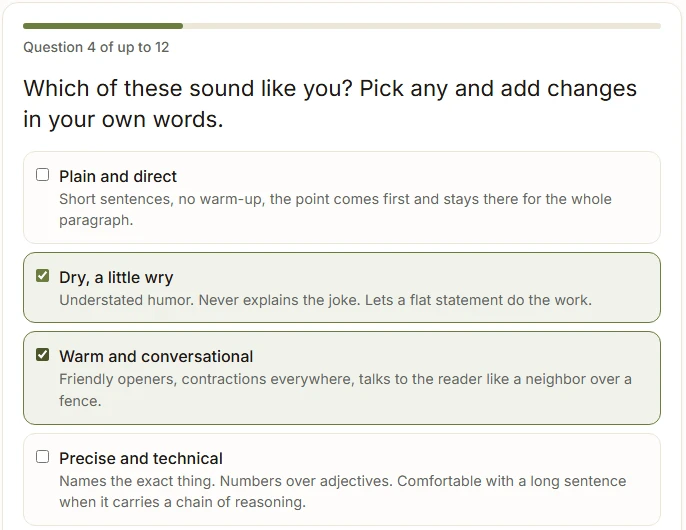
The interview keeps track of how much of your voice it actually knows: how formal you are, how long your sentences run, the words you use and avoid, how you start and end, and what you never want to sound like. It only counts something as known from your own words or your picks, and it checks that any quote it reads into an answer really appears in what you wrote.
Before anything is saved, it writes a short sample in your voice on a topic you pick. If it is not quite right, say what is off and it asks about that part again. Then you read every rule, and nothing is saved until you say yes.
Your voice lands as ordinary memories in the workspace you choose, so any assistant connected to Empirical can look it up. If you work in Claude Code or Codex, the optional voice plugin looks your voice up whenever the agent writes as you:
empirical plugin install claude --voiceThe writing you paste is deleted once your voice is saved. Writing Voice is on every paid plan.
Empirical Tokens
A few features do a lot of AI work for you, and Writing Voice is the biggest of them. Empirical Tokens are how we cover that without raising everyone's price.
- Every paid plan includes a monthly allowance: Starter 200, Builder 1,000 and Architect 2,400.
- Building a writing voice costs 200, which is one full interview on Starter. A workspace interview costs 100.
- You see the cost before anything starts. If you do not have enough, nothing starts and nothing is charged.
- Your allowance resets at the start of each month, and the reset is shown in your own time zone.
- You get an alert at 80% and at 100%, and
empirical usagein the CLI shows what is left.
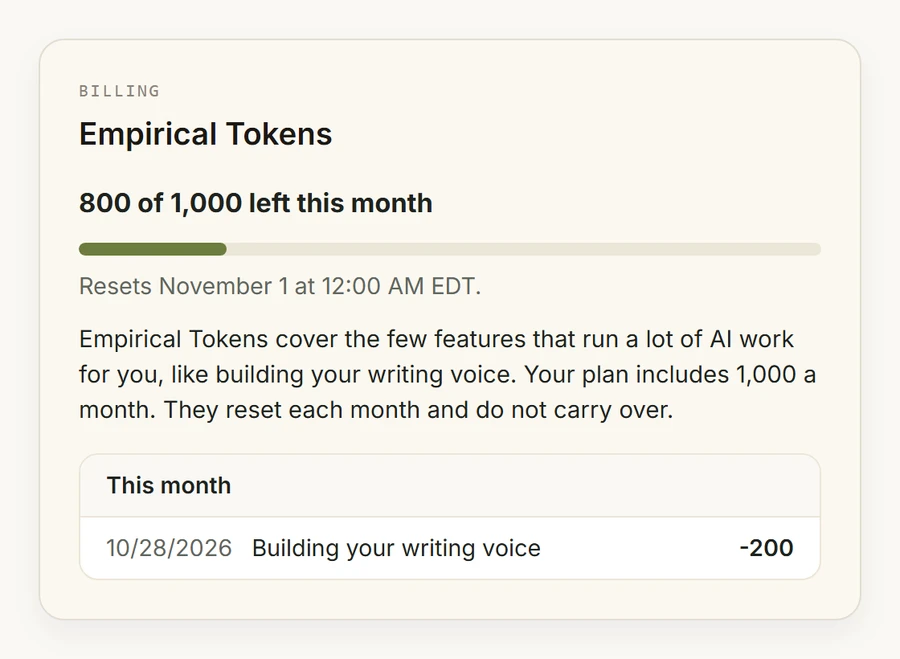
Memories, recall, reminders and everything else you already use do not touch Empirical Tokens.
Workspaces that know what they hold
Until now a workspace was a folder of memories. Now it can have a shape: the kinds of things it holds, like leads, projects or decisions, each with its own stages.
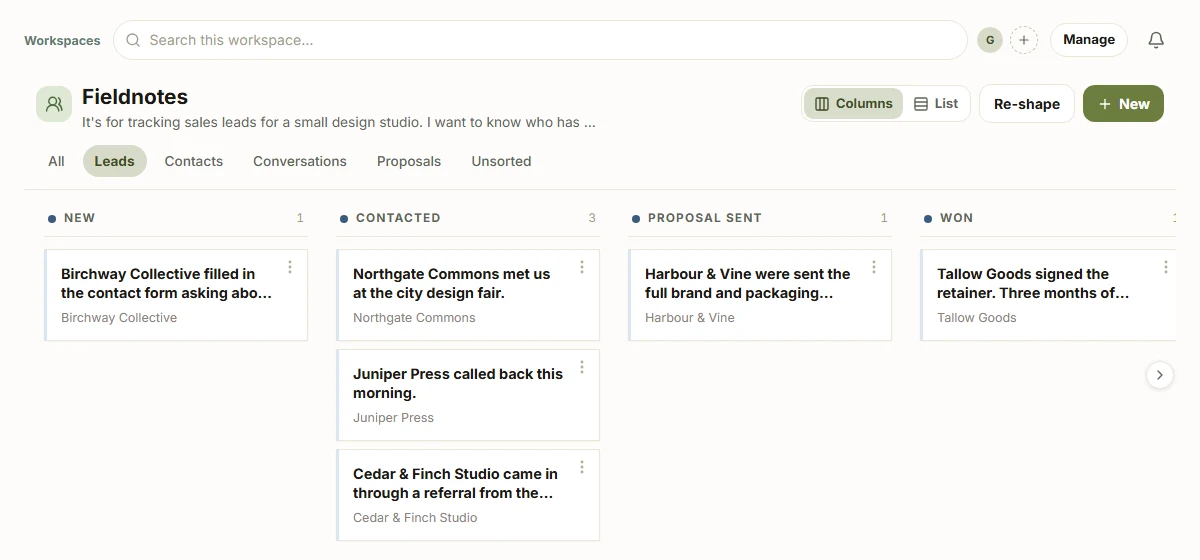
- Shape it with an interview. Tell it what the workspace is for and it proposes the types, stages and fields. Run it from the portal, from an agent, or from the CLI.
- A board, not a list. Each type shows up as columns by stage. Drag a card to move it along, and open it in a side panel so the columns keep their width.
- Things land where they belong. What your agents save goes to the right type and stage.
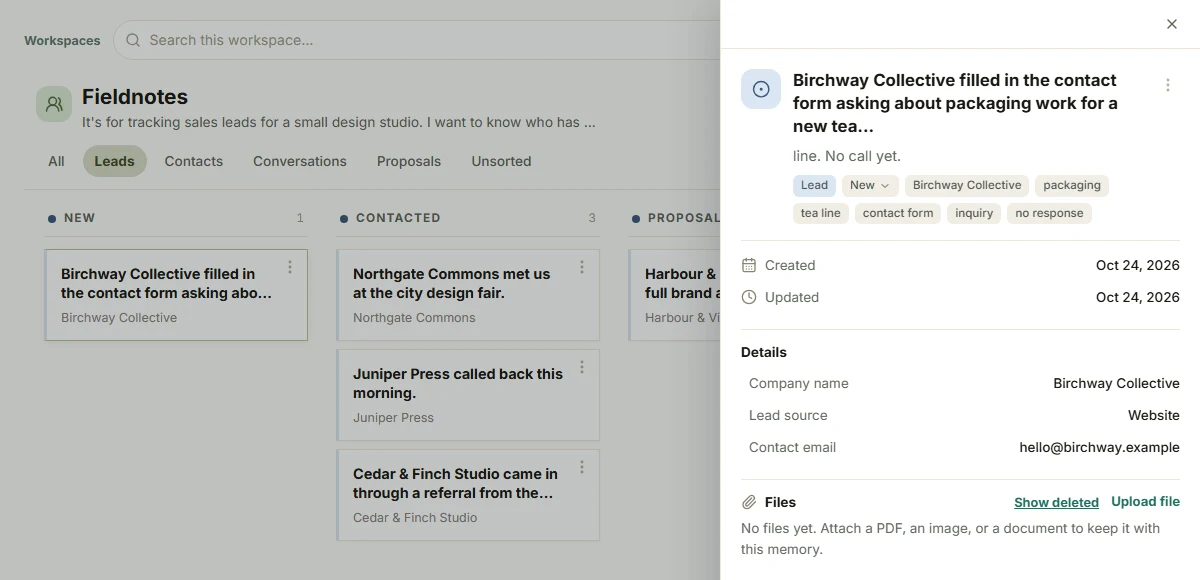
- Nest and move. Put a meeting under the lead it was about, or move a whole project, and everything under it, to another workspace.
- Agents can do it all. Two new tools,
create_workspaceandset_workspace_shape, mean you can just ask your agent to set up a workspace for something. - Bring people in. Invites now reach people by email, and memories in a shared workspace count against whoever pays for it. Builder now includes 5 shared workspaces, up from 3.
See workspaces or read You told your agent about the lead. Then you typed it into the CRM again.
Files on a memory
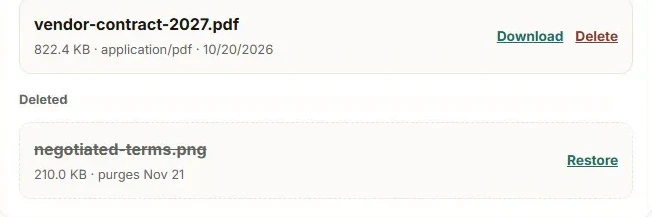
A memory can now carry the files it is about: the signed contract next to the decision, the screenshot next to the bug.
- Up to 20 files per memory, 25MB each.
- Attach from the portal, from the CLI, or from an agent, which can hand over a link or the text it just wrote.
- Agents can read files back when they recall the memory.
- Deleting a file is reversible for thirty days, and the receipt tells you the purge date.
- Attachments need a paid plan.
A smarter Daydream
If you have Daydream on, it now does more than reflect your memories back at you.
- Real talks. On Builder and up, Daydream can bring you a real YouTube talk that connects to what you are working on, checked to exist before it is sent.
- Every channel. If you turned on more than one channel, every one of them now gets your Daydream, not only the first.
- Fixed for Discord. Some accounts set to Discord without a linked Discord account were not getting Daydreams at all. They now fall back to email.
- Sources picked for you. We have started building each person's Daydream from sources chosen around what they are actually working on, refreshed nightly instead of monthly. It is running for a small group first and rolls out from there.
Empirical in more places
- The Claude plugin is approved. The Empirical plugin for Claude Code passed Anthropic's review, and the Empirical connector is close to being published in the Claude directory.
- An updated ChatGPT app. The Empirical app for ChatGPT has more tools available over MCP.
- The best experience is local. If you use Claude Code, Codex or Copilot on your own machine, install the CLI. You get automatic recall at the start of every session, workspaces bound to each project folder, and skills like Work History and Scar Tissue. One command installs it and signs you in. Install the CLI
Smaller things
- Faster recall when you filter by tag. Tag-scoped searches now run inside the database, so they come back faster on large memory graphs.
- One recall everywhere. The portal's search box now goes through the same recall your agents use.
- New MCP tools. Agents can attach, list, read, delete and restore files (
attach_file_to_memory,list_memory_attachments,get_memory_attachment,delete_memory_attachment,restore_memory_attachment), and create and shape workspaces. - New CLI commands.
empirical usageshows your Empirical Tokens,empirical memory attachmentadds, lists, downloads, deletes and restores files, andempirical plugin install claude --voiceadds the voice plugin.
Almost ready: DolphinBench
We have been running Empirical through DolphinBench, a public benchmark for agent memory. The run is almost done, and the results are looking very good. Very promising. We will share the full results once it is finished.
It's never been a better time to join Empirical
Your assistants can write like you, your workspaces know what they hold, your memories keep their files, and all of it follows you across ChatGPT, Claude, and every agent you run locally. Set it up once and every AI you use remembers.
If you are already here, thank you. Tell me what you want next, and I will read it.