You told your agent about the lead. Then you typed it into the CRM again.
A CRM for leads. A todo list with reminders. A tracker for the work. Built out of what you already said to an AI, so nobody fills in a form twice. Here is what lands where, why the classifier is allowed to answer "the record does not say", and the three places it stops.
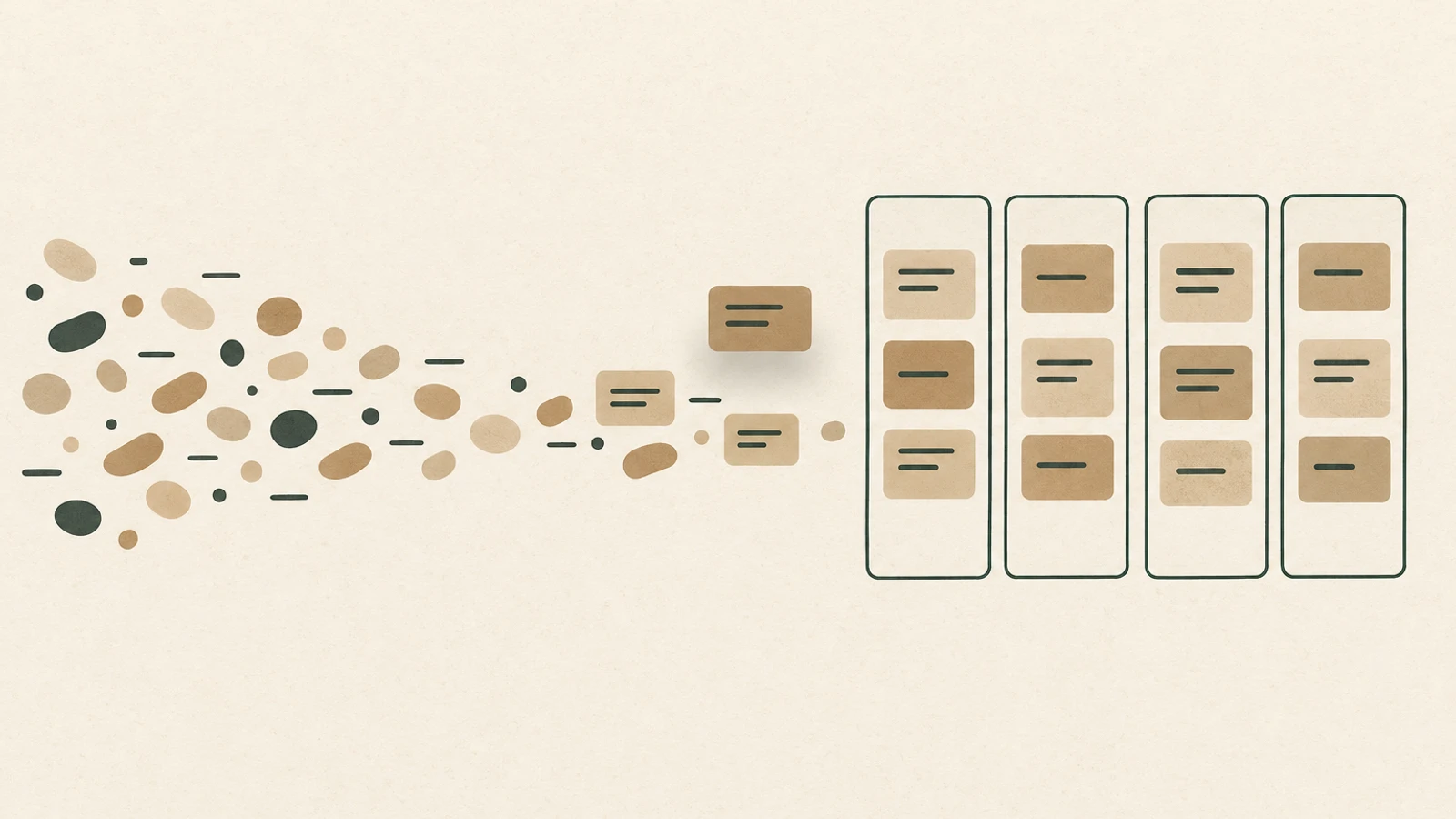
You already said it once.
A designer spends twenty minutes with an AI working out what to quote a new client. A solo dev talks through which idea is worth building next. A founder argues themselves out of a vendor, with reasons.
Then each of them opens the tool that is supposed to hold that, and types it in again. Shorter, worse, a day late.
That second typing is the whole job. Not thinking. Not deciding. Re-entry.
Workspaces deletes it.
One sentence, filed
Here is the entire interaction. You talk to the assistant you already use. It saves what matters as you go.
Birchway Collective filled in the contact form asking about packaging work for a new tea line. No call yet.
Saved to Fieldnotes as a Lead, under Birchway Collective, with the contact email from the form. No stage set, because nothing has happened yet.
No form. No column to pick. You said a thing about work, and the thing about work is now a record with a type, a company, a source and an email on it.
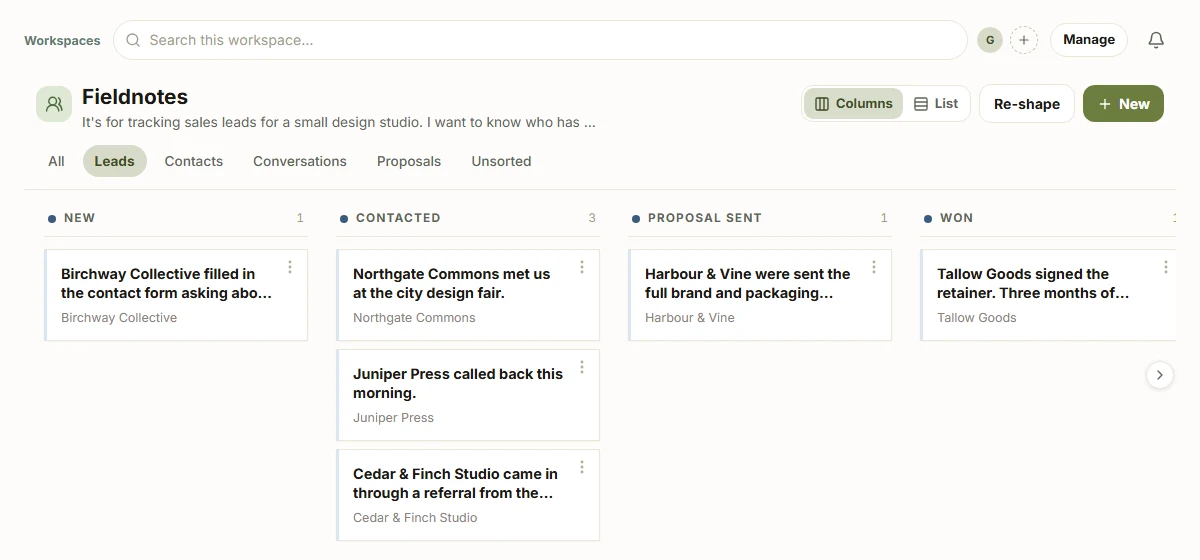
What it maps to
A reader called John looked at the landing page and said the most useful thing anyone has said about this feature:
I'm still struggling to understand how it's not just a list of the memories. I think I need it to tell me what it can do for me.
Fair. So, plainly. Depending on what you do, a workspace is:
| If you | It is your | Holding |
|---|---|---|
| sell anything | CRM | leads, contacts, proposals, who has gone quiet |
| ship anything | work tracker | sessions, decisions, blockers, what shipped |
| run anything | decision log | vendors, pricing, hires, why you chose that |
| keep having ideas at 11pm | idea tracker | ideas, sub-ideas, the one you actually started |
One shape, defined once. Not three products and a Sunday spent wiring them together. And you never open it to put something in, because your AI already did that while you were talking.
Why it is not just a list of memories
A memory is a sentence that happened. An item has a kind, a stage, fields and a due date, which is what lets a column mean something and a filter answer a question.
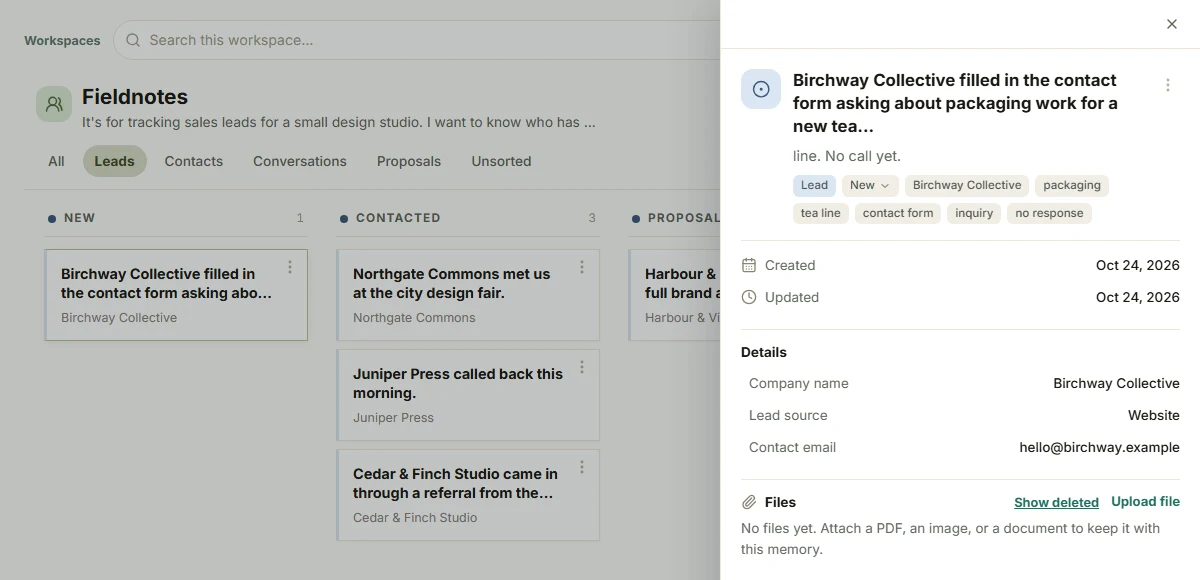
Same sentence as before. It is now a Lead at stage New, for Birchway Collective, sourced from the website, with an address to reply to. Give it a due date and it becomes a reminder that emails you, with a calendar invite attached.
The setup is an interview, not a blank screen
You do not invent columns. About six questions, in the agent or in the browser, and it proposes the whole thing back to you: the kinds of item, the stages each kind moves through, the fields worth keeping, and a policy or two.
One policy it offers a sales shape, in its own words:
Set a follow-up reminder for new leads unless they are immediately closed, won, or awaiting a client response with a known date.
Change it or accept it. Nothing is written until you say yes. It costs 100 Empirical Tokens, which is the model budget for the session. After that, writing to it is free.
The part I would actually defend: it can refuse
Your agent should set the kind of item when it writes, and good ones do. When it does not, a classifier called Jev picks it up afterwards, without holding up your write, and never overwrites a type your agent chose.
Since October 24 it gets asked a second question: which stage. Two questions, not one, because stages belong to a kind of item. There is no such thing as "the stages of a workspace", so there is nothing to ask until the kind is known.
The interesting bit is what the second question allows as an answer. Next to the real stages sits an explicit the record does not say, described as the default.
Measured against the live API:
| what somebody actually said | kind | stage |
|---|---|---|
| "Birchway filled in the contact form asking about packaging" | Lead @1.00 | none |
| "Commercial land inquiry came through the form" | Lead @1.00 | none |
| "Called him back this morning" | Lead @0.89 | Contacted @0.79 |
| "Sent the proposal Tuesday" | Lead @1.00 | Proposal sent @0.99 |
| "They signed, the deal is closed" | Lead @1.00 | Won @0.99 |
The bottom three are the easy half, and they are not the point. The top two are.
Both are obviously about a lead. Neither says one thing about progress. A forced choice files both as New at a confidence high enough to clear any floor you care to set, because the confidence a model reports is confidence among the lanes it was offered, never confidence that anything was said.
So, yes, there are floors, 0.55 for the kind and 0.75 for the stage. They are not what saves you. The option to say nothing is.
The cost of getting this wrong is not an untidy board. It is a card sitting in a column that says somebody did something when nobody did. An item with no stage looks unfinished and you fix it in a second. A confidently wrong stage looks finished, and you believe it.
Why look at it, when you could just ask
John's sharpest objection: "I'm not sure why I'd want to look at it instead of just asking the agent for the info."
Because asking answers one question at a time, and you have to already know the question.
"Where does everything stand" is not one question. It is forty at once, and a conversation is bad at it. What a board does that a chat cannot is show you the thing you forgot to ask about. Five leads sitting at Contacted for nine days is not an answer. It is something you notice.
The work still happens in the conversation. The screen is for the ten seconds on a Monday when you need the shape of all of it.
Where it stops
Three limits, up front rather than discovered.
It is paid, two ways over. A shape only exists on a shared workspace, and the allowance is 0 on Free, 1 on Starter, 5 on Builder, 20 on Architect. The interview spends 100 tokens against a monthly grant of 0 / 200 / 1000 / 2400. Starter has had a shared workspace all along, which our own pricing page got wrong until recently.
There is no setup-free version. You need the CLI or the MCP server connected to the AI tool you already use. Nothing writing to it means an empty workspace with good intentions.
The CLI cannot shape one directly. empirical workspace create and create --interview both work. empirical workspace shape is a re-shape by interview, so it spends tokens. A direct shape today is MCP (set_workspace_shape) or REST. That gap is real and it is on the list.
And the one that follows from the section above: nothing files itself except that one fallback, only in a shaped shared workspace, only when the shape has at least two kinds of item, and only for a stage when the chosen kind has at least two. Anything else lands untyped until somebody says what it is.
Watch it happen in a terminal. That is where the work is. The screen is downstream.