Blueprints now interview you before they install anything
A canned memory graph made your assistant sound like a template. The new guided setups interview you, branch on what you say, and turn the transcript into real memories your assistant uses from the first question you ask.
Blueprints were supposed to fix the empty-account problem. You sign up, connect ChatGPT or Claude, and your memory graph has nothing in it, so the assistant has nothing to recall. A blueprint installs a ready-made graph of goals, rules, and checks for a domain like founder operations or code auditing, and the assistant has something to work with on day one.
That was the theory. In practice, blueprints had 16 installs across the product's whole life, and most of them were mine. When I read the installed content honestly, I understood why. It was generic. "Respect existing architecture patterns" is not a memory about you. It is a poster.
So over the last few weeks blueprints got rebuilt around one idea: the blueprint should ask you questions, and the graph it installs should be built from your answers.
This post walks through the new flow with real screenshots from my own account, shows exactly what lands in your workspace, and shows a connected assistant using it. I also list what is still rough, because I found some of it while writing this.
What changed
- Guided interviews that branch. Eight blueprints now start an interview instead of a plain install: Founder Operating System, My Work Setup, Job Search, Health and Energy, Deliberate Practice, Mentorship and Growth, Subscription and Billing, and MCP Tool Building. Every interview is a tree, not a list: eight or nine core questions, and each answer can unlock follow-ups based on what you said. In Founder Operating System, mention a co-founder and it asks how decisions split between you; say you are solo and it asks what you deliberately do not do. In Job Search, saying you are interviewing gets you asked about the live pipeline; saying you are negotiating gets you asked about the offer. A full session runs 15 to 25 questions and takes 20 to 30 minutes.
- Your transcript becomes real memories. When the interview finishes, the whole transcript is turned into 15 to 25 atomic memories: one specific fact each, in your own terms, with numbers, names, and dates kept as you gave them, and each one linked to the blueprint rules it bears on. Nothing is inferred or embellished. If that step is unavailable, a quoted copy of each answer is installed instead, so you never get a blank or a template placeholder.
- Redo setup. Installed guided blueprints have a Redo setup button. Re-answer the interview and the same install is rebuilt in place instead of a duplicate appearing.
- Updates keep your answers. Updating a guided blueprint to a new version used to overwrite your personalized nodes with the template text. That is fixed and covered by regression tests.
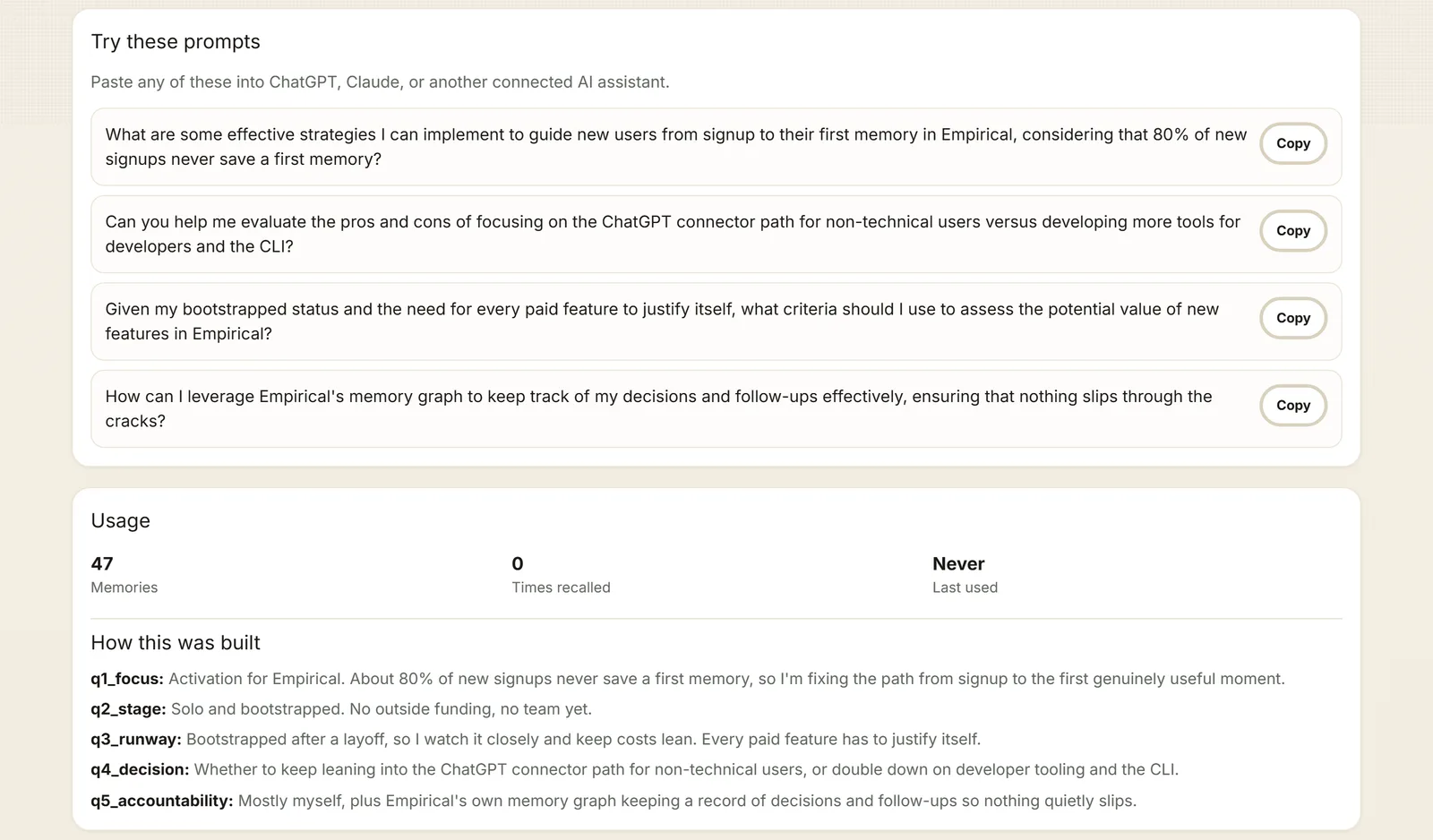
- Sample prompts and provenance. After install, the blueprint page shows prompts written against your actual answers, plus a "How this was built" panel listing what you said.
- Agent-native access. Everything above is reachable from ChatGPT, Claude, or any MCP client through the guided setup and blueprint functions, so an assistant can run the interview in chat.
- Content rewrite. All 23 blueprints were rewritten from interchangeable template content to real domain rules, and a content gate now blocks publishing anything that reads like a template.
The walkthrough
Everything below is my real account, captured today against production. I picked Founder Operating System because I am a solo founder and the answers would be true.
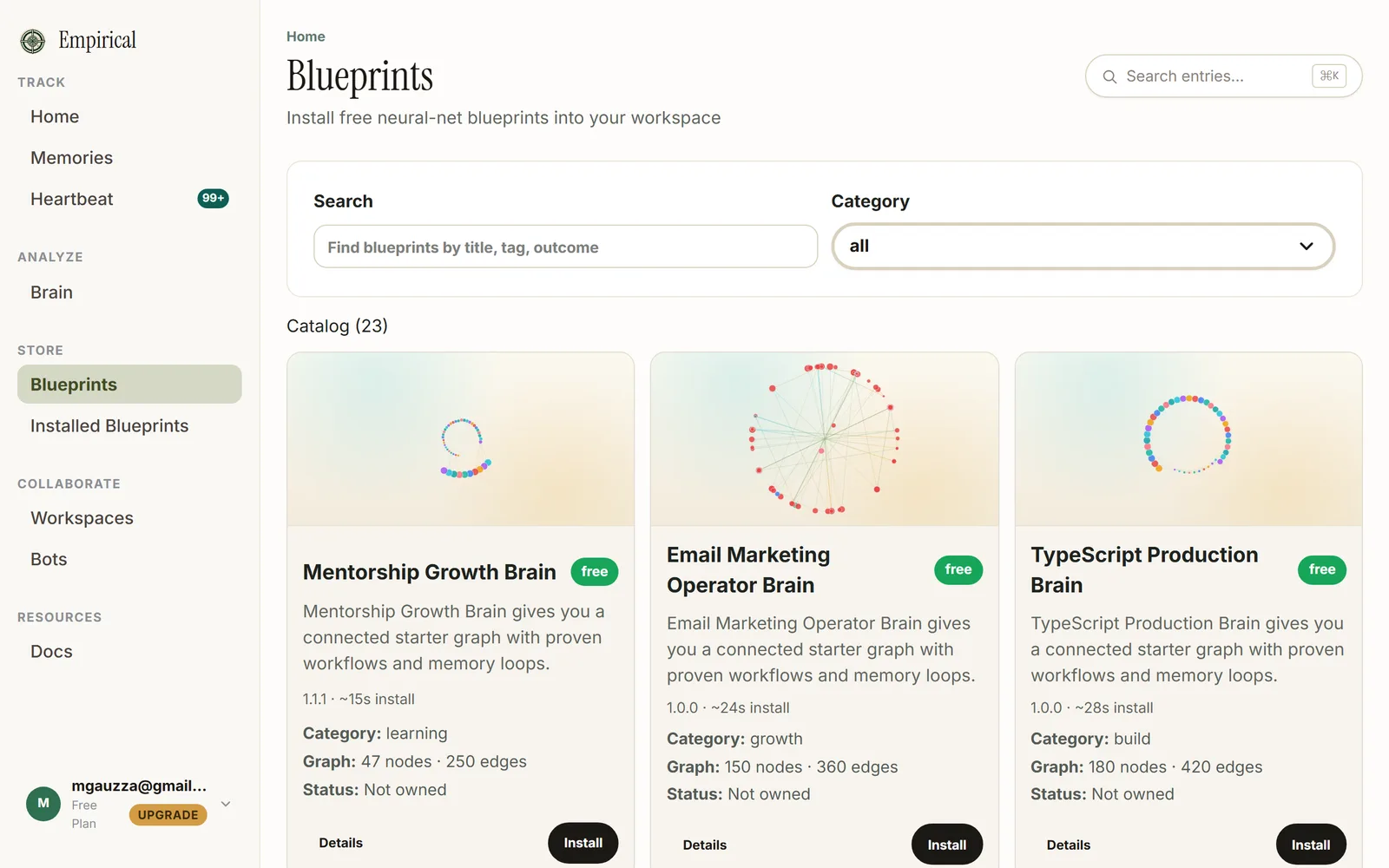
The store lists the catalog. Blueprints that require an interview say so on their detail page.
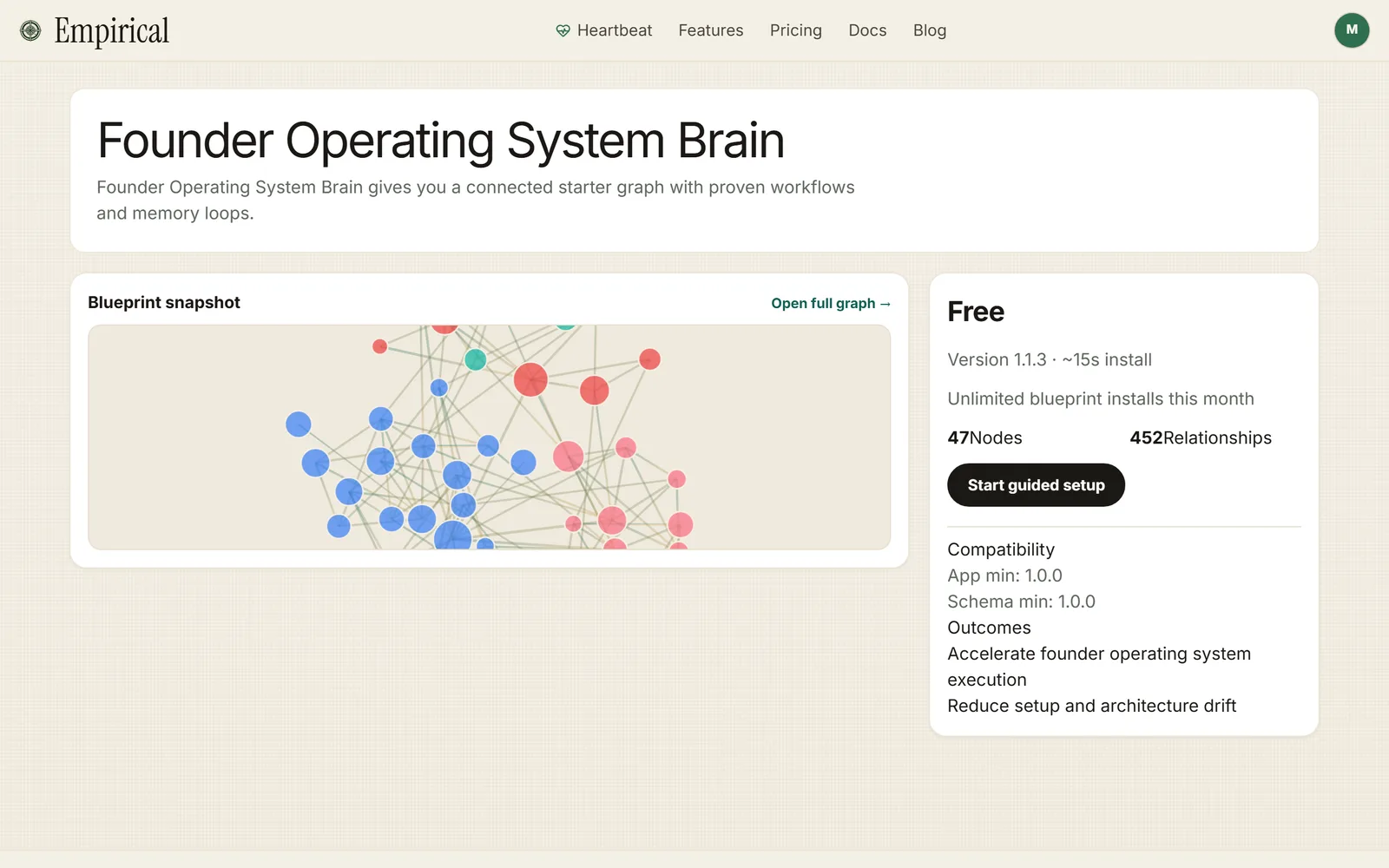
On the detail page, the install button becomes "Start guided setup". The graph snapshot on the left is the blueprint before your answers: 43 founder operating rules, plus placeholders the interview replaces with facts about you.
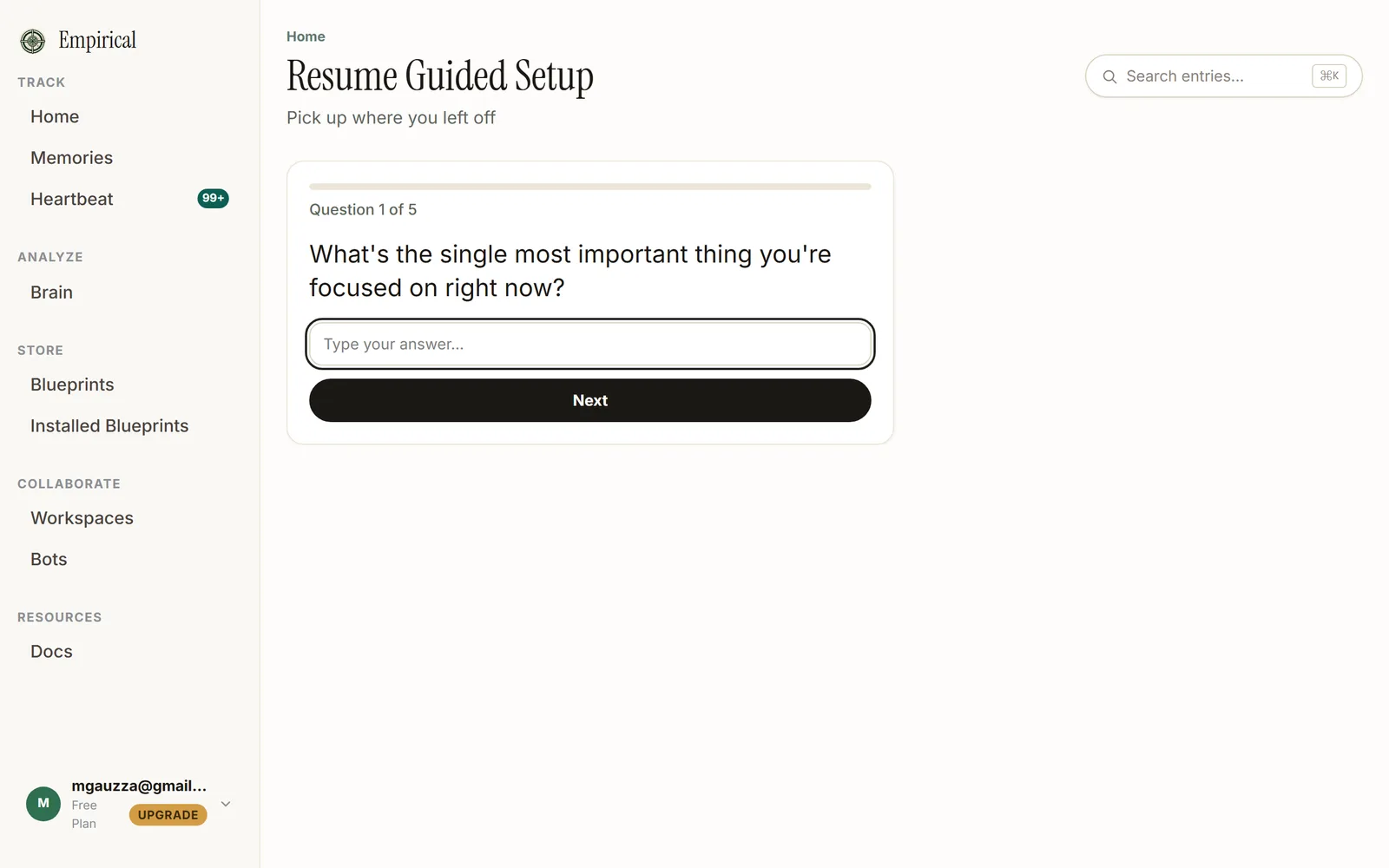
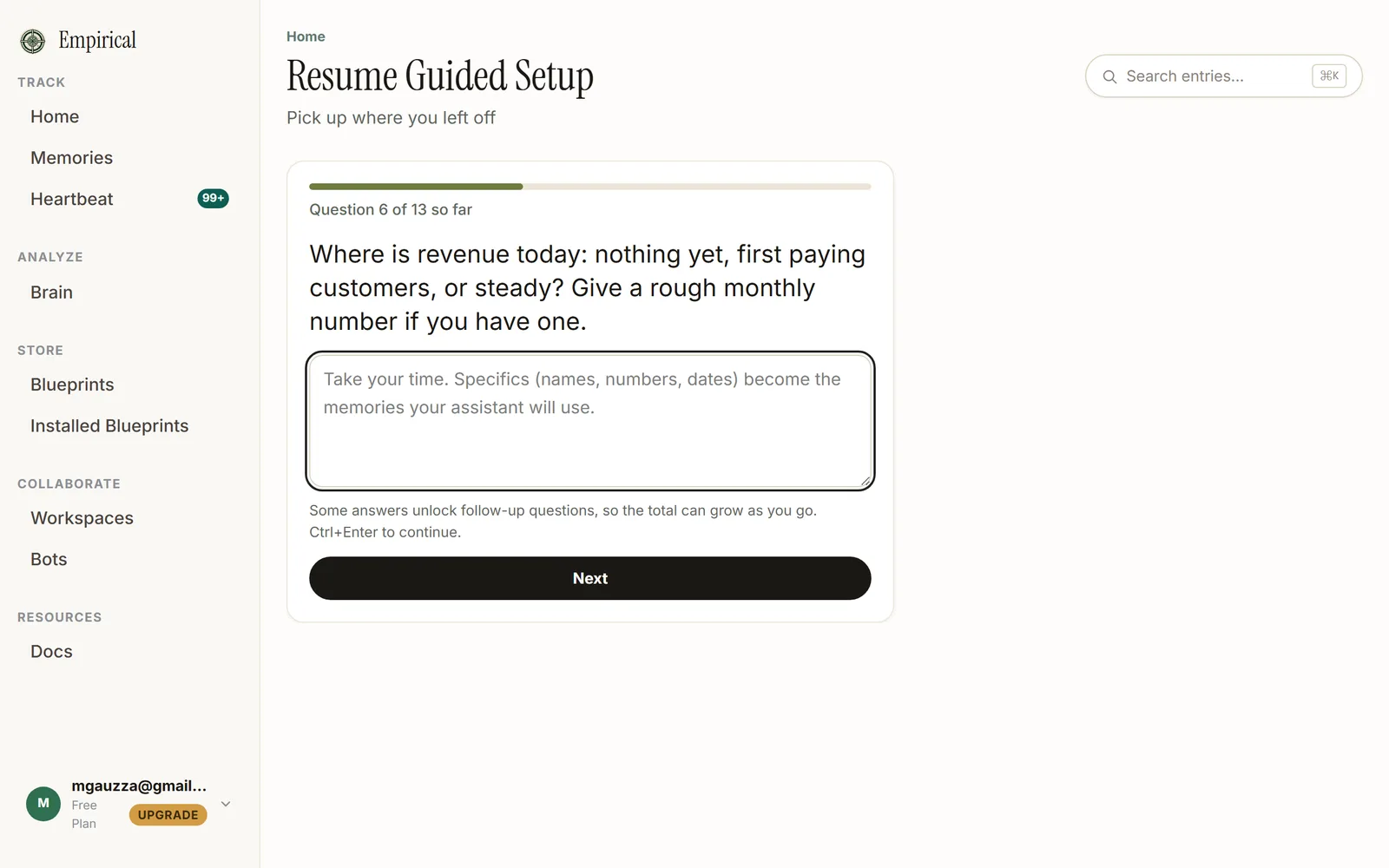
The interview is one question at a time with a progress bar. The total grows as your answers unlock follow-ups. Nothing is installed yet.
Six questions in, the total has already grown from nine to thirteen because of what I said about being solo and having paying customers. Whatever you type here is what your assistant will read back to you later, so it is worth full sentences and real numbers.
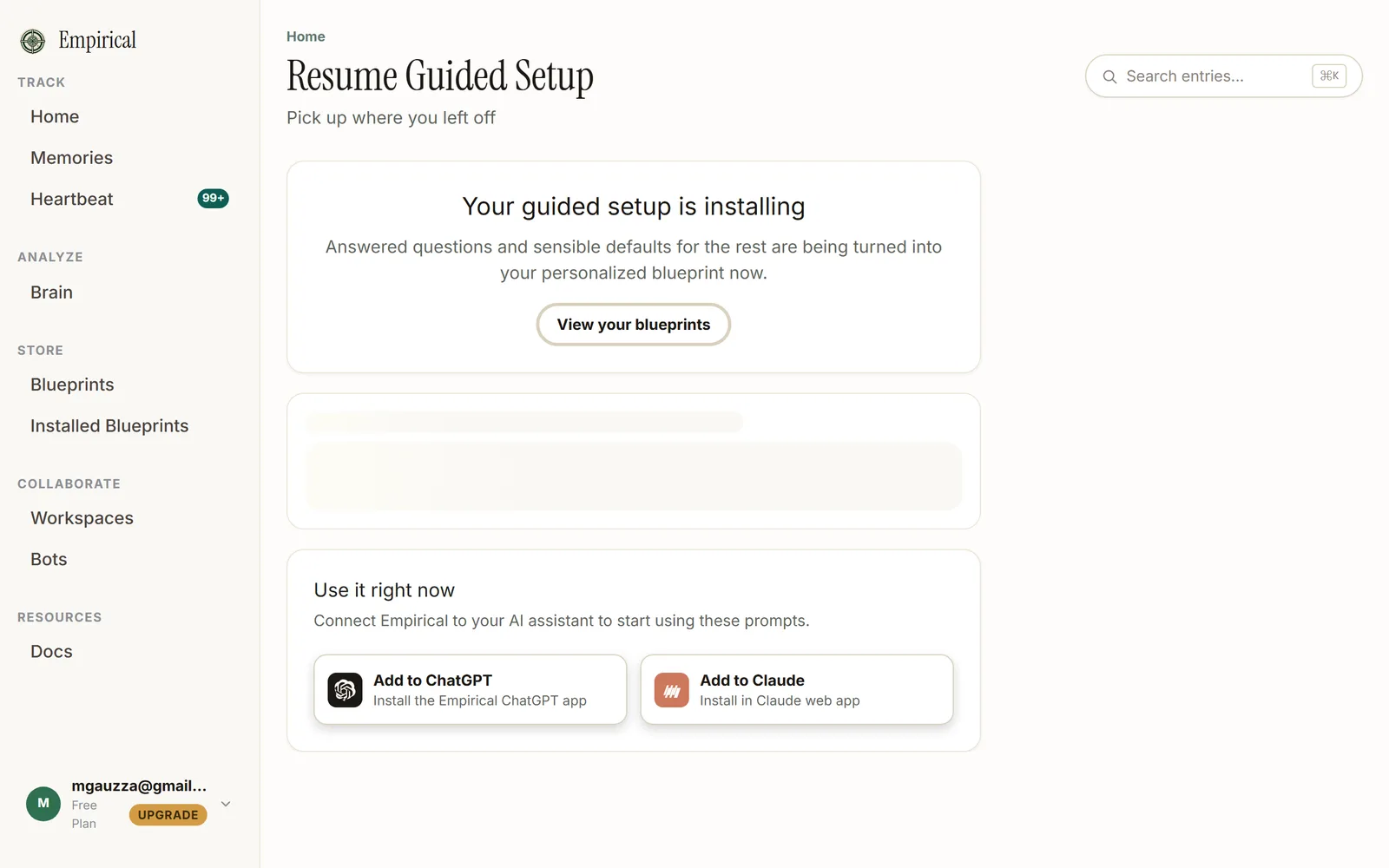
After the last answer the install runs in the background. The completion page links to the installed blueprint and to the ChatGPT and Claude connectors.
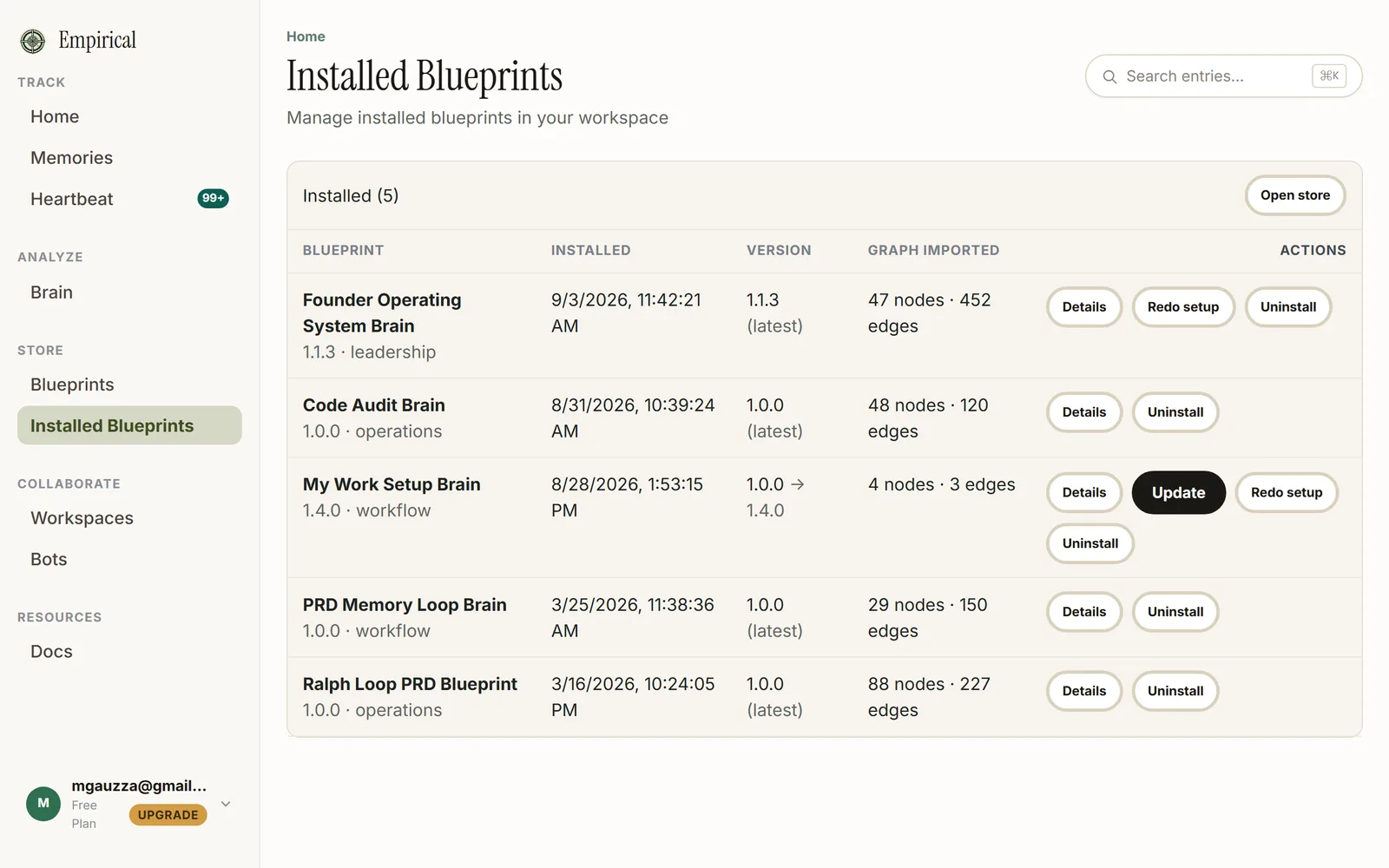
Installed Blueprints now shows the Founder OS install alongside the older ones, with Redo setup available on the guided ones. Note the My Work Setup row has an Update available: taking that update now preserves the interview answers instead of overwriting them.
Back on the detail page, the install is done and two new panels appear. "Try these prompts" is generated by a model against your real answers, not a template. "How this was built" is the provenance record: every answer that went into the graph, so you can see why the assistant knows what it knows.
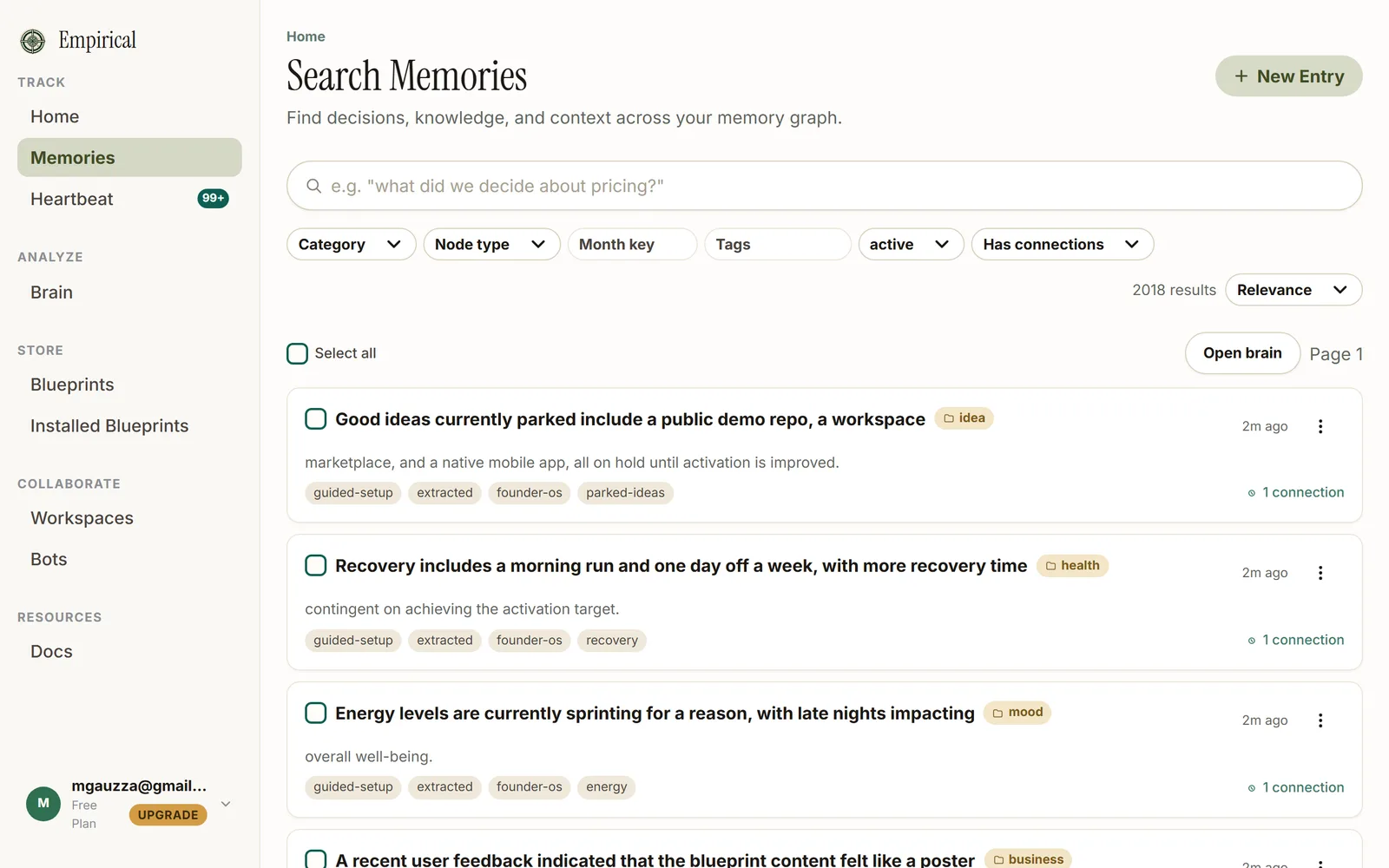
And the extracted facts are ordinary memories. They show up in Search Memories, tagged guided-setup and extracted, and you can edit or delete them like anything else.
What it actually sets up in your environment
Here is the whole install, counted from the memories it created in my workspace.
| Part | Count | What it is |
|---|---|---|
| Root node | 1 | "Founder operating system baseline: protected focus, logged decisions, and honest runway/energy tracking" |
| Domain clusters | 7 | Weekly planning, decision logging, scope discipline, runway awareness, customer signal, energy, accountability without a team |
| Rule nodes | 35 | Five checkable rules per cluster, such as "Unfinished priorities are explicitly carried forward or dropped, never silently forgotten" |
| Extracted facts | 15 to 25 | One per fact you gave: your focus and what "done" means, stage, revenue and runway in your numbers, the decision you are weighing with its options and deadline, who keeps you accountable, how your week gets planned, what you are deliberately not pursuing |
| Relationships | about 480 | Every rule contributes to its cluster anchor, every anchor to the root, and each extracted fact hangs off the root and off the domain it belongs to, so it sits next to the right rules when the assistant retrieves it |
A few details that matter more than the counts:
- It lands in the workspace you are in. Personal workspace by default. Nothing is shared with a team unless you install it inside a team workspace.
- Every node carries provenance. Each memory records the blueprint, version, and install it came from. Uninstall removes what the blueprint created and nothing else. If you edit a node, it is detached and treated as yours, so an uninstall or update never deletes it.
- Facts are written as standalone statements, not fields. An early version stored "Current focus: activation" and the assistant rarely found it. Extracted facts read like a note a sharp chief of staff would keep, in the third person and without a name, which is what makes the retrieval below work.
- Skipping is honest. Finish early and the memories come from what you actually said. Unanswered questions never invent anything about you.
The assistant using it
This is the part that matters. A few minutes after the interview I asked my connected assistant a question a founder actually asks. Behind the scenes it called Empirical's memory search, the same way ChatGPT or Claude does once they are connected. Here is the exchange.
What's the most important thing I'm focused on right now?
You told me it is activation for Empirical: about 80% of new signups never save a first memory, so you are fixing the path from signup to the first genuinely useful moment.
One of your Founder OS rules also applies here: the single most important thing gets protected time before anything else fills the calendar. Block that time for activation work before the week fills up.
The first half of that answer is my own interview answer. The second half is one of the blueprint's rules, retrieved alongside it. That pairing is the whole point of installing the rules and the answers into one graph: the assistant gets what I said I am doing and a principle for how to protect it, in the same breath.
A second question, about spend:
How should I think about spend right now?
You are solo and bootstrapped, with no outside funding and no team yet. You described your runway as something you watch closely after a layoff, keeping costs lean, and you said every paid feature has to justify itself.
So treat anything that adds a fixed monthly cost as a decision, not a default, and hold off on hiring until activation moves.
The assistant knows not to suggest hiring or a paid tool spree, because I told it once, in a form it can find.
One honest caveat. My graph has over 2,000 memories from months of work, and a loosely worded question like "what should I focus on this week" did not surface the interview answers on the first try. Four new memories compete with everything else. For a new account, which is who guided setups are for, those memories are most of the graph and come back first. For a dense graph, ask the way you answered, or start from the generated sample prompts, which are phrased to hit.
Try it
The store is at /blueprints. Blueprints are part of every paid plan, and the guided interviews, including Founder Operating System and My Work Setup, run in the web app today.
If you would rather do it in chat, connect Empirical to ChatGPT or Claude and say "list my guided setups". The assistant calls list_guided_setups, starts the one you pick, asks you the questions, and installs the result. The MCP tools reference has the function list.
The bar I am holding this to is simple. If the assistant references something you told it in the interview, unprompted, in a normal conversation, guided setups are doing their job. If it sounds like a poster, tell me.
Let the assistant interview you.
Sign up for Empirical, or upgrade your account, and install a blueprint from the store. The guided interviews run in the web app today, and your answers become memories every connected assistant can use.